Open source · Local deployment · All platforms

OpenClaw

🦞 Your AI agent army, running on your computer

OpenClaw is an open-source personal AI assistant platform—run it locally and get started fast. Command it via WeChat, Feishu, DingTalk, and more: it can send emails, manage calendars, write code, browse the web, and work for you 24/7.

🪟
Windows
🍎
macOS
🐧
Linux
🤖
Android
📱
iOS
☁️
Cloud
Tip: hover over the agents—they’ll wave back.
⟋⟋ Download

Choose your platform and get started fast

Supports Windows, macOS, Linux, and mobile (Android, iOS). Local deployment—your data stays on your device.

🪟
Windows
Windows 10/11 · x64 & ARM
🍎
macOS
macOS 14+ · Universal Binary
🐧
Linux
Ubuntu / Debian / Fedora
📱
Mobile
Android & iOS
✉️

Email automation

Auto-triage, summarize, and reply—works with major email providers.
Gmail Outlook Auto-reply
🗓️

Calendar & scheduling

Manage calendars across platforms with conflict detection, reminders, and smart scheduling.
Feishu DingTalk Google
🧑‍💻

Code assistant

Code review, bug fixes, test generation, PR management, and remote CI/CD triggers.
GitHub GitLab CI/CD
🧩

Automation workflows

Automated browsing, form filling, data extraction, and workflow orchestration.
Data capture Auto form fill Monitoring
📊

Sheets & analytics

Import Excel/CSV, analyze automatically, and generate charts and insights.
Excel SQL Visualization
🏠

Smart home

Control devices via chat and connect to mainstream home automation platforms.
Mi Home HomeKit Automation
⟩ One API for global LLMs

Simple setup. No one-by-one signups. Unified access.

Use one API for mainstream models—zero integration churn, ready out of the box.

Mainstream models & providers
OpenAI · GPT-4o / o1 Claude · Opus / Sonnet Gemini · Pro / Ultra DeepSeek · V3 / R1 Qwen · Qwen Max Doubao · Doubao Pro Moonshot · Kimi Zhipu · GLM-4 Baidu ERNIE · ERNIE 4.0 Minimax · abab6.5
Bulk pricing + smart routing lowers cost at the same quality. Not happy? Switch models instantly—no code changes.
🔌

Unified API

One API across providers—avoid repetitive integrations and maintenance.
💸

Cost optimized

Route by cost and quality so your budget goes where it matters.

One-click switching

Swap models per task and quickly find the best result.
⟩ Visual control, at a glance

Skip the CLI—configure everything in a UI.

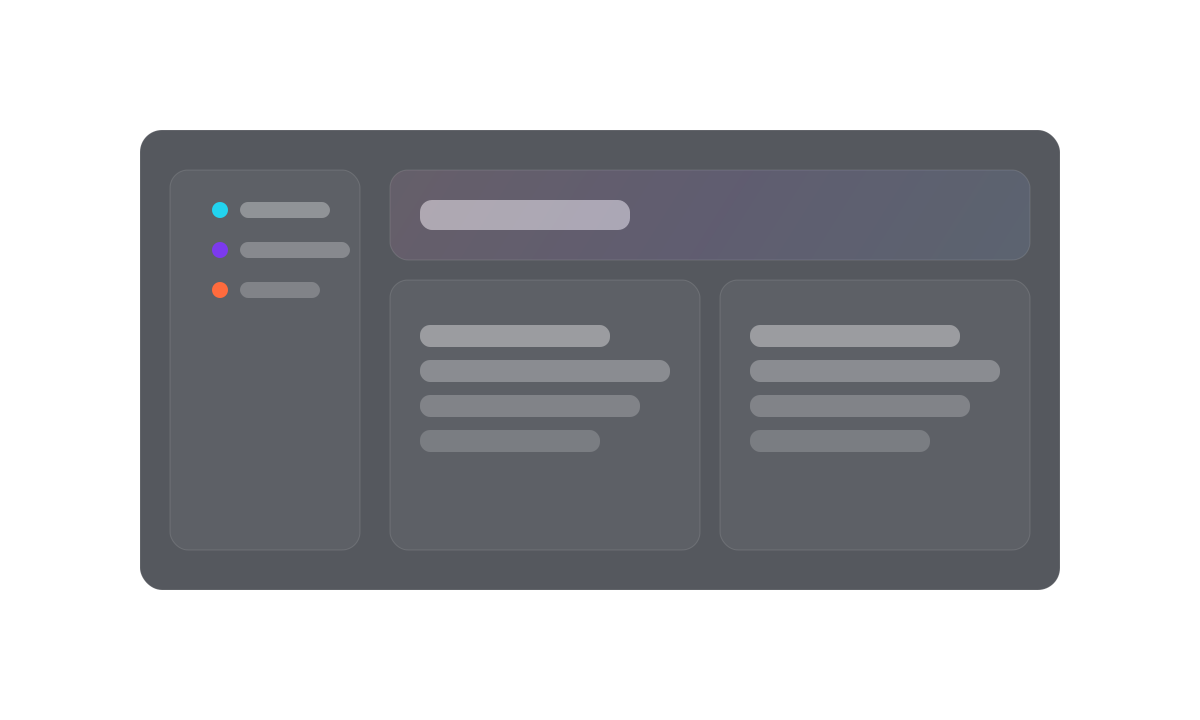
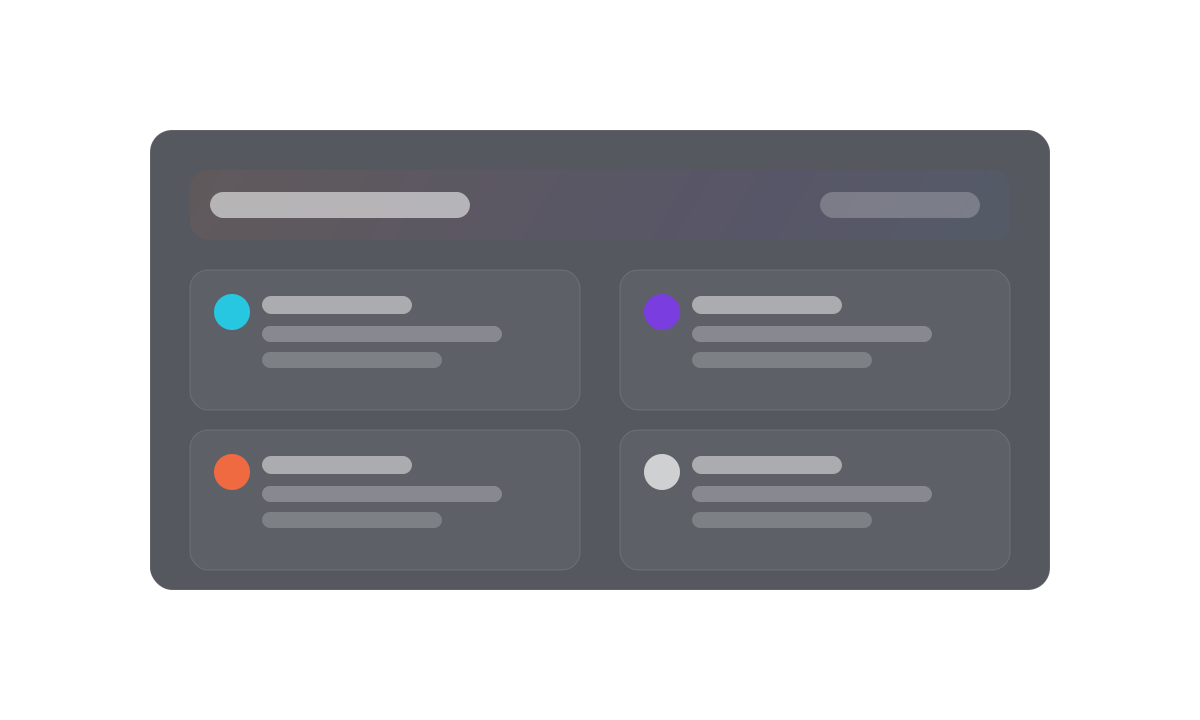
Service status, model providers, integrations, and permission policies—one-click in the dashboard.
Service status
See service status at a glance and start/stop with one click.
Provider setup
Configure multiple providers and customize API endpoints.
Chat integrations
Connect chat platforms and build an omnichannel assistant.
Tip: click screenshots to enlarge.
⟩ Integrations

Connect to the chat platforms you already use

No new app required—chat with your lobster in the tools you already use, anytime.

WeChat WeChat
Supported
Feishu Feishu
Supported
DingTalk DingTalk
Supported
WeCom WeCom
Supported
Telegram Telegram
Supported
Discord Discord
Supported
Slack Slack
Supported
Signal Signal
Supported
⟩ Capabilities

Not just chat—AI that gets work done

Your lobster can operate a computer end-to-end—anything you can do on a PC.

🧠
Persistent memory
Remembers preferences, habits, and context—gets better the more you use it. A true long-term companion.
🖥️
Full system access
Read/write files, run scripts, and control a browser. Sandbox or full access—your choice.
🤖
Multi-model compatible
Supports Claude, GPT, DeepSeek, Qwen, and local open-source models.
🔒
Local-first, privacy-controlled
Runs on your device—data doesn’t leave your machine. Open and transparent.
Proactive work
Scheduled tasks, background monitoring, and alerts. The lobster detects issues and reports back.
🔧
Self-improving
Can write new skills and adjust configuration. Tell it what you want—it implements it.
⟩ Your data, your rules

Command approvals and directory access control—always in your control.

Every real action has guardrails: authorize, restrict, and audit to prevent overreach.

Command-level approval

Every system command requires explicit approval, with allowlist/denylist policies.
📁

Sandboxed file access

Strict directory boundaries—agents can’t access files outside your defined workspace.
⟩ Quickstart

One command to wake your lobster.

A typical flow: install, onboard, connect a chat platform, then start assigning tasks.

openclaw onboard
openclaw connect --platform wechat
After that, just chat like you would with a teammate—context-aware and able to take real actions.
What can it do?
UI demo
Email
Auto-reply
Calendar
Smart scheduling
Web
Form filling
Dev
Fix tests
You approve and constrain actions to keep everything safe and controlled.
⟩ What users say

Feedback from real users.

A few highlights that feel “from the future.”

User avatar
“After years of AI hype, I thought nothing would impress me—until I installed @openclaw.”
@lycfyi
User avatar
“It’s like a coworker with eyes and hands at your computer—message it and it can do anything you can.”
@nathanclark_
User avatar
“Persistent memory, persona guidance, chat integrations… a few rough edges, but the experience is fantastic.”
@AryehDubois
User avatar
“It’s open source—your context and skills stay on your own machine, not in a walled garden.”
@danpeguine
User avatar
“OpenClaw gets a lot of the hard parts right. I’m genuinely impressed.”
@AryehDubois
User avatar
“Even if models stop getting stronger, we’ll spend years finding new uses—@openclaw is that kind of leap.”
@markjaquith
User avatar
“Incredible value: runs tests, catches errors, fixes them, and opens a PR. The future is here.”
@nateliason
User avatar
“I ran OpenClaw for a week—you can control it and customize it instead of relying on a tech giant.”
@snopoke
User avatar
“Installed @openclaw yesterday… chatting in Discord and it keeps building itself. Wild.”
@steipete
User avatar
“It runs my company.”
@therno
⟩ FAQ

FAQ

Common questions about security, permissions, and multi-model setups.

The desktop app is “plug-and-play”: installer/upgrades, a visual configuration panel, one-click integrations for common platforms, and safer defaults (tighter permissions, confirmations, logging/alerts) so non-developers can start quickly. The open-source core is the extensible foundation: a unified agent runtime, plugin/skill system, model/tool abstractions, orchestration, and memory—ideal for customization. Use both: start with the desktop flow, then extend capabilities with plugins on the core.

Yes—use layered guardrails. 1) Command-level approvals via allowlists/denylists and read/write/exec scopes. 2) Directory sandboxing by limiting readable/writable paths to a workspace. 3) Confirmations and auditing for side-effect actions (delete, payments, emails, broadcast messages). 4) Least privilege and isolation with separate accounts, containers/VMs, and outbound network policies.

Yes. Treat models/providers as a capability pool: route by task type (writing vs. coding vs. latency-sensitive tasks) and by cost (reserve expensive models for critical steps). Add failover so rate limits/timeouts automatically switch to a backup model. Keep providers/models/keys/quotas centralized in configuration, and set different defaults per environment.

This page is a bilingual static-site template for matching a reference design (colors, layout, interactions) so you can preview and customize locally. Replace and extend placeholder content like download links, integrations, and testimonials for your real product/project. If you publish it, verify branding and all outbound links (downloads, docs, community, GitHub), document security boundaries clearly (defaults, sandboxing, confirmations), and add resiliency (mirrors, fallback links, status messaging).

Ready to awaken your AI agent army?

Open source, free, local-first, privacy-controlled, and extensible.